When Is it Too Cold to Paint Outside
Timing an exterior painting project around the weather is one of the more consequential decisions a homeowner makes. Get it right and the finish lasts a decade. Get it wrong and you are looking at peeling, bubbling, and adhesion failures within weeks. This guide covers the full picture: the minimum temperature thresholds for different paint types, the physical chemistry behind why cold kills a paint job, how to read environmental conditions beyond the air temperature reading, and how to diagnose problems if cold-weather painting has already happened.
At what temperature should you not do exterior painting? Fifty degrees Fahrenheit is the consensus minimum threshold for latex-based exterior paint application. Below this temperature, water-based paint emulsions cannot evaporate and coalesce properly, resulting in weak film formation and adhesion failure. Product-specific data sheets may specify different minimums; always consult manufacturer guidance for your exact paint before scheduling a project.
For homeowners who want the work done right without tracking weather windows, Ace Hardware Painting Services handles residential exterior painting with scheduling built around proper temperature and humidity conditions from start to finish. If cold weather is compressing your project window, professional planning takes that variable off your plate entirely.
The 50°F Threshold: Why This Temperature Matters for Exterior Paint
Fifty degrees Fahrenheit is the consensus minimum threshold for latex-based exterior paint application. Below this temperature, water-based paint emulsions cannot evaporate and coalesce properly, resulting in weak film formation and adhesion failure. Product-specific data sheets may specify different minimums; consult manufacturer guidance for your exact paint.
This threshold is not arbitrary. Latex paint forms its protective film through a two-step process: water evaporates from the emulsion, and the acrylic or vinyl-acrylic particles fuse together into a continuous, flexible coating. Both steps require enough thermal energy to proceed. At temperatures below 50°F, evaporation slows dramatically, and the polymer particles lack the energy to coalesce into a proper film. What results is a coating that looks applied but behaves more like a powder pressed to the surface.
Benjamin Moore specifies an application range of 35°F to 100°F for certain products, which reflects advances in low-temperature formulation. That lower threshold, however, applies to specific products engineered for cold-weather performance and documented in their Technical Data Sheets. Using the 35°F figure as a blanket permission for any latex paint is a mistake. The operative rule: the product data sheet for your specific paint governs. If it says 50°F, that is the floor. If it says 40°F, confirm it explicitly in the documentation before proceeding.
How Cold Temperatures Break Down Paint: The Chemistry of Cure Failure
Understanding the mechanism behind cold-weather failure helps a painter make better decisions at the margins rather than just memorizing a number.
Latex paint is an emulsion of polymer particles suspended in water with additives that control flow, leveling, and adhesion. When applied to a surface, the water carrier needs to evaporate. As it does, the polymer particles pack together and fuse through a process called coalescence. For coalescence to succeed, the particles must be above their minimum film formation temperature (MFFT). Most standard exterior latex formulations have MFFTs in the 40-50°F range. Apply the paint at or below the MFFT and the particles cannot fuse; the resulting film is chalky, porous, and structurally weak.
Oil-based paints cure through a different process: oxidative polymerization. The binder reacts with oxygen in the air and cross-links into a hard film. This reaction proceeds at lower temperatures than water evaporation, which is why oil-based exterior paints can typically be applied down to around 40°F. The trade-off is that cold significantly extends cure times even for oil-based products, stretching what would normally be a 24-hour recoat window to 48 hours or longer.
Cold also introduces a moisture problem independent of the evaporation issue. When surface temperatures approach the dew point, condensation forms on the substrate. Paint applied over even a thin film of moisture will not bond properly to the surface beneath, regardless of how warm the air is. This is why painting early on a cold morning, when surfaces have not yet warmed above the dew point, creates adhesion problems even if the air temperature technically clears the minimum threshold.
Latex vs. Oil-Based Paint: Different Cold Thresholds, Different Risks
The two main categories of exterior paint behave fundamentally differently in cold conditions, and treating them interchangeably leads to miscalculation.
Standard latex exterior paint, including most vinyl-acrylic and acrylic-latex formulations, requires a minimum of 50°F for both air and surface temperature. Below that floor, water cannot evaporate fast enough to drive coalescence, and the resulting film is compromised. Standard oil-based exterior paint can tolerate application down to approximately 40°F because the oxidative cure mechanism is less dependent on temperature-driven evaporation. However, cure times at 40°F for oil-based products stretch considerably, and the paint remains vulnerable to damage until the cure is complete.
Acrylic-Latex and Premium Formulations
100% acrylic exterior paints and premium exterior formulations occupy a middle ground. Some are engineered with coalescent additives that lower the MFFT, allowing application in temperatures as low as 35°F under the right conditions. These products typically carry a higher price point and, critically, have their cold-temperature capability documented in their Technical Data Sheets. The label or data sheet for Benjamin Moore Aura Exterior, for example, lists different minimum temperature requirements than a standard vinyl-acrylic formulation from the same manufacturer. Always pull the Technical Data Sheet for your specific product and confirm the minimum application temperature before assuming cold-weather capability.
Temperature vs. Drying: Why Paint Will Not Dry Below 50°F
Paint may feel surface-dry below 50°F but will not cure completely. Cold temperatures prevent proper evaporation and chemical transformation of the binder, leaving the film weak and susceptible to peeling months later. This is why waiting for cold-weather drying does not solve the problem.
The distinction between drying and curing is critical. Drying refers to the surface-level loss of solvents or water carrier; it is what makes the paint feel dry to the touch. Curing is the full chemical transformation of the binder into a durable, cross-linked film. These are sequential processes, and in cold weather they diverge sharply. A paint surface can feel dry because the outermost water has evaporated, while the layers beneath remain uncured and structurally weak. The practical implication: a coat that feels dry after an hour at 45°F is not ready for a second coat, is not ready for hardware re-installation, and will not perform like a properly cured film.
Homeowners who know they are working near the temperature threshold sometimes reason that they can apply paint and simply wait longer for it to dry. This reasoning applies to drying time, not to cure mechanics. Below the minimum film formation temperature, the polymer particles will not coalesce regardless of how many hours pass. The film will remain structurally compromised until it is stripped and reapplied under correct conditions.
Surface Temperature, Air Temperature, and Paint Temperature: Three Numbers That Matter
Air temperature is the most accessible reading, which is why it dominates the conversation, but it is not the only number that determines whether conditions are suitable for painting.
Surface temperature is what actually matters for adhesion. The paint is applied to the substrate, not the air. On a cold but sunny day, dark exterior surfaces like black shutters or dark brown siding can reach temperatures 20 to 30°F above ambient air temperature when exposed to direct sun. Conversely, north-facing walls in shade on the same day may be 10 to 15°F below air temperature. A 55°F air reading might mean a 75°F south wall and a 45°F north wall simultaneously. Painting in cold conditions requires checking the actual substrate temperature with an inexpensive infrared thermometer, not assuming air temperature is representative.
Paint temperature is the third variable. Paint stored in an unheated garage through a cold night can drop to 35 or 40°F even if outdoor air temperature rises to 58°F by mid-morning. Applying cold paint to a warmer surface creates a mismatch that affects flow, leveling, and cure. If paint has been stored in cold conditions, bring it indoors to return to room temperature for at least 24 hours before use. Do not attempt to warm it artificially with direct heat, which can damage the emulsion.
 Humidity and Moisture: The Secondary Cold-Weather Enemy
Temperature gets most of the attention in cold-weather painting discussions, but humidity is a close second and the two variables interact in ways that make the combined risk greater than either alone.
Cold air holds less absolute moisture than warm air, which might suggest that cold-weather painting faces less humidity risk. The issue is relative humidity and dew point. As air temperatures drop, surfaces cool toward the dew point faster, and condensation forms on substrates even when relative humidity readings appear moderate. A surface at 52°F in air at 60°F with 75% relative humidity may be close enough to the dew point that invisible condensation is forming on the substrate. Painting over that surface, even with air temperature technically above 50°F, will produce adhesion failures.
The standard upper limit for exterior painting humidity is 85% relative humidity. In cold conditions, the effective threshold is more conservative; at temperatures near 50°F, keeping humidity below 70% provides a meaningful additional safety margin. Rain and morning dew are obvious disqualifiers. Less obvious is the window between dew evaporation in the morning and dew formation in the evening. On cool days, this productive painting window may be only a few hours wide.
Consecutive vs. Single Cold Temperatures: Understanding Real-World Weather Patterns
Weather forecasts rarely show clean, consistent temperatures across a multi-day painting window. Understanding how temperature patterns affect a paint project prevents miscalculation when conditions are borderline.
A single overnight dip to 42°F following an afternoon application at 65°F is a different scenario than three consecutive days forecast to stay at 45°F. Paint applied on a warm afternoon, with surfaces at proper temperature and several hours of warmth remaining before nightfall, may reach sufficient initial set before temperatures drop. In contrast, paint applied on a marginal 52°F afternoon and immediately followed by two days of below-threshold temperatures may never cure properly even if the application-moment conditions were technically acceptable.
The practical decision framework: before scheduling an exterior painting day, pull a 48-hour forecast. Conditions should meet minimum temperature requirements not just during application hours but for at least 24 hours following the last coat. If the forecast shows temperatures dropping below 50°F within 12 hours of when the final coat is planned, reschedule. Weather forecasts within a 48-hour window are reliable enough to make this assessment. Forecasts beyond 72 hours carry enough uncertainty that scheduling based on them introduces real risk in marginal-temperature seasons.
What Happens When You Paint Below 50°F: Failure Modes and Visual Signs
Painting in cold creates visible and hidden failures: immediate runs and sags; adhesion loss within weeks, shown by peeling; mold growth inside weak coatings; and permanent gloss loss from incomplete coalescence. Assessment timing: some issues appear within days, others within months as temperature fluctuations stress the weak film.
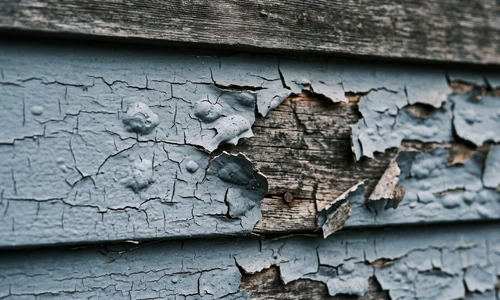
Runs and sags appear during or immediately after application when the paint is too cold to level properly. These are the most visible early indicators. Loss of sheen or a flat, chalky appearance where gloss or satin was expected signals incomplete coalescence; the polymer particles failed to merge into a reflective, uniform surface. Adhesion failures typically manifest two to six weeks after application, often accelerated by the first warming cycle that stress-tests the weak film against the surface. Peeling and flaking at this stage usually requires complete removal and recoating rather than patch repair.
Moisture trapped in an incompletely cured film creates an environment hospitable to mold and mildew growth on the coating surface, often appearing within the first season. This is more common on north-facing or shaded surfaces where the substrate stays damp longer after cold-weather application.
If you have already applied paint in marginal temperature conditions and are seeing early signs of poor adhesion or incomplete cure, professional assessment of the coating can determine whether immediate recoating is needed or whether the application is likely to hold through the season. Ace Hardware Painting Services handles situations where exterior work needs to be properly remediated and recoated under correct conditions.
Reading Product Labels and Technical Data Sheets: Your Paint's Specific Requirements
Product data sheets are the source of truth for application temperature requirements, and most homeowners never look at them. Knowing where to find the information and how to read it prevents relying on general rules that may not apply to the specific product in use.
Technical Data Sheets for most major exterior paint lines are available as PDFs on the manufacturer's website, searchable by product name. The temperature section typically appears under "Application Conditions" or "Application Instructions" and specifies the minimum air temperature, minimum surface temperature, maximum humidity, and often the minimum temperature that must be maintained for a stated number of hours after application. All four of these figures matter; the minimum air temperature is typically the most prominent but not necessarily the most restrictive for a specific project.
When a Technical Data Sheet lists, for example, "Apply when air and surface temperatures are between 50°F and 90°F," the and is not incidental. Both must be met simultaneously. The sheet may also specify a minimum overnight temperature of 35°F for the 24-48 hours after application, recognizing that the curing window extends well beyond application day. Review your paint's Technical Data Sheet to confirm your specific product's minimum temperature requirement; manufacturers' specifications always supersede general guidance.
Seasonal and Regional Planning: Cold-Weather Painting Windows
The 50°F minimum threshold creates meaningful seasonal constraints depending on geographic location, and planning around those constraints is more effective than trying to work through marginal conditions.
In northern states where overnight temperatures drop below 50°F reliably from mid-October through April, the exterior painting window is roughly late May through early September for reliable condition management. Spring and fall shoulder seasons are possible but require attentive forecast monitoring; a 60°F day in October may be followed by a 38°F night that undermines the cure. Southern and coastal regions typically extend the painting window into November and open it in March, though specific frost risk and coastal humidity require the same assessment discipline.
Transition zone states face the most variable conditions. A warm week in late September followed by an early cold snap can catch painters mid-project. The conservative approach in shoulder seasons is to plan projects with a completion date at least two weeks before historical average first frost dates, providing buffer for unexpected early cold. Scheduling exterior painting in the core of summer carries its own risks at the other end of the range; temperatures above 90°F can also create application problems, including rapid skinning and lap marks. The optimal exterior painting window in most climates is late spring through early fall, favoring mornings when temperature and humidity are both within range.
Interior vs. Exterior: Why Indoor Painting Is Not Constrained by Temperature
For homeowners whose exterior painting window has closed due to cold weather, interior projects offer a productive alternative that climate control makes feasible year-round. A climate-controlled interior maintains consistent temperature and humidity regardless of outdoor conditions, eliminating the cure and adhesion risks that cold creates for exterior work. Bedrooms, kitchens, bathrooms, trim, and ceilings are all viable winter projects when exterior scheduling has been pushed to spring. This is also the right time to plan exterior colors, order samples, and confirm product selections so that when conditions return to range, the project can move without delay.
Special Considerations for Challenging Cold-Weather Conditions
Certain substrates and situations require additional caution beyond standard cold-weather thresholds.
Masonry and concrete surfaces, including brick, block, and stucco, retain cold longer than wood or metal. A concrete wall can hold temperatures 10 to 15°F below air temperature for hours after morning temperatures rise. Masonry also absorbs and releases moisture differently than wood, which amplifies the condensation risk at lower temperatures. Specialty masonry primers and paints often carry their own specific minimum temperature requirements, typically higher than standard exterior latex.
Previously painted surfaces showing existing cracking or flaking are more vulnerable to cold-weather application failure than sound substrates. The marginal adhesion of an already-compromised surface, combined with the weakened bond of a cold-weather application, compounds the risk. These surfaces benefit most from correct-temperature application because the margin for error is narrower.
Metal surfaces, including railings, gutters, and trim, conduct cold efficiently and often need direct sunlight for several hours before surface temperatures meet application minimums, even when air temperatures are acceptable. Checking metal substrate temperature directly with an infrared thermometer is particularly important on cold-weather painting days.
When the project involves challenging substrates, marginal seasonal timing, or surfaces with existing coating issues, Ace Hardware Painting Services provides exterior painting services with condition assessment built into the scheduling process so the work is done when conditions are right.
Maintenance and Long-Term Care for Exterior Paint in Cold Climates
A correctly applied exterior coat holds significantly longer than one applied in marginal conditions, but long-term performance still requires periodic attention regardless of how well the original application was executed.
- Inspect exterior painted surfaces each spring after the first freeze-thaw cycle, looking for any cracking, flaking, or adhesion loss at edges and joints.
- Address small areas of peeling or cracking promptly; cold-weather moisture infiltration behind a compromised coating accelerates the spread of failure.
- Clean exterior painted surfaces annually with low-pressure washing to remove mildew, chalk, and contaminants that hold moisture against the coating.
- Repaint wood surfaces when the existing coating shows more than 20% chalk or begins to lose its ability to bead water; do not wait for full failure before recoating.
- Recoating over a sound existing coat is significantly less invasive than full strip-and-repaint; catching deterioration early preserves that option.
- In cold climates, schedule repainting for the core warm season rather than pushing into fall to allow full cure before freeze-thaw cycles stress the new coating.
 Things to Consider Before You Start
- What does my paint's Technical Data Sheet specify as the minimum application temperature? General guidance is a starting point; the product spec is the requirement.
- Have I checked surface temperature on the specific walls I am painting, not just the air temperature at midday? North-facing surfaces and shaded areas may be well below air temperature.
- Is the paint stored at room temperature, or has it been sitting in a cold garage? Cold paint creates application problems even in acceptable outdoor conditions.
- What does the 48-hour forecast look like after my planned application day? Temperature at application time matters, but so does the overnight low for the following two nights.
- What is the current humidity, and will it stay below 85% throughout the painting window? Dew point calculation matters near the temperature minimum.
- Am I painting a substrate that holds cold longer than wood, such as masonry or metal? If so, check surface temperature directly before starting.
- Is this a large enough project that a cold-weather setback would create significant rework, or is this a small section where marginal conditions carry acceptable risk?
The honest answer for most homeowners is that exterior painting is a warm-season project for good reason. If any of the above questions cannot be answered with confidence, the project is a candidate for professional scheduling rather than DIY execution in marginal conditions.
Why Homeowners Bring in Ace Hardware Painting Services
Exterior painting in cold weather is one of the situations where professional planning, material knowledge, and proper scheduling make a concrete difference in how long the finished job lasts.
- Premium Benjamin Moore paints and stains are included as the standard scope of work, including premium exterior formulations engineered for durability across temperature and moisture cycles.
- Color consultation and color samples are included, so homeowners can finalize exterior color selections during winter months and be ready to move when spring painting conditions arrive.
- Our crews assess air temperature, surface temperature, and humidity before beginning each day's work; conditions that do not meet thresholds mean rescheduling, not compromising the job.
- Strong workmanship guarantee covers the finished project, providing recourse if any application-related issues arise after project completion.
- No sprayer, extension poles, or specialty ladders to rent, source, or return; all equipment arrives with the crew.
- Background-checked professional crews handle the project from prep through cleanup on a predictable weekday timeline.
- Complete cleanup is included; paint cans, tape, drop cloths, and debris leave with the crew at the end of each day.
- The Ace Hardware name behind every job means a service standard that homeowners recognize and rely on from retail applied directly to home services work.
If your exterior project has been pushed by cold weather or you want the work done right without managing condition windows yourself, your local Ace Hardware Painting Services office can schedule an estimate and plan the project around the right conditions. Get an Estimate today.
Frequently Asked Questions
Will paint dry in 40-degree weather?
Paint may feel surface-dry at 40°F because the outer layer of water evaporates, but it will not cure properly. Most latex exterior paints require 50°F minimum for the polymer particles to coalesce into a durable film. A paint that feels dry at 40°F has not undergone the cure process and will be structurally weak, prone to peeling and adhesion loss as temperatures warm.
What is the minimum temperature for exterior painting?
For standard latex-based exterior paints, the consensus minimum is 50°F for both air and surface temperature. Oil-based exterior paints can generally tolerate down to 40°F due to their oxidative cure mechanism. Premium 100% acrylic formulations with low-temperature additives may specify as low as 35°F on their Technical Data Sheets. Always confirm the minimum for your specific product before applying in cool conditions.
What happens if you paint outside below 50 degrees?
Below 50°F, latex paint fails to form a proper film because polymer particles cannot coalesce. The visible results include runs, sags, and loss of sheen immediately after application. Adhesion failures typically appear two to six weeks later as peeling and flaking. Moisture trapped in the weak coating can also promote mold growth. Most of these failures require full removal and repainting rather than patch repair.
Does Sherwin-Williams or Benjamin Moore specify different minimums than 50°F?
Benjamin Moore specifies an application range starting at 35°F for certain exterior products, notably premium 100% acrylic formulations. That threshold applies to products engineered for cold-weather application and is listed on the product's Technical Data Sheet. Sherwin-Williams similarly differentiates by product line. The general 50°F rule is a safe default, but the authoritative answer for any specific paint is always its own Technical Data Sheet, not a universal threshold.
Can I paint exterior at night or early morning when it is 40°F but the afternoon reaches 65°F?
Painting should happen during the warmest part of the day when both air and surface temperatures have cleared the minimum threshold and are forecast to remain above it for at least 24 hours. Painting at 8 a.m. when surfaces are still 42°F creates failure conditions even if the afternoon will reach 65°F. The surface needs to warm above the minimum before application begins, and the overnight forecast following application matters as much as the application-moment temperature.
How do I know if cold-weather painting already damaged my exterior paint job?
Early indicators include a flat or chalky appearance where sheen was expected, visible runs or sags in the dried film, and soft or tacky areas that do not harden with time. Adhesion failures typically appear two to six weeks after application as small blisters, edge lifting, or flaking sections. If any of these signs appear, assess the extent of the affected area before the first warm-season temperature cycle stresses the weak film further and accelerates the spread.